Thursday, January 31, 2013

Tripura Sundari Temple Banswara Rajasthan

Tripura Sundari Temple is situated about 20 km from Banswara headquarters near Talwara village in Rajasthan. The presiding deity is Goddess Lalita Tripura Sundari (meaning the beauty of the three worlds) who is one of the forms of Goddess Shakti. Popularly called as Matabari, Tripurasundari Temple in Rajasthan is regarded as one of the 108 Shakti Peethas in India. Tripura Sundari is called as Turtia Mata by the local people. According to mythology, Lord Vishnu cut the body of Goddess Sati into pieces by his Sudarshana Chakra. These parts fell at different places which are known as Sakthi Peethas. It is believed that the right foot of Sati fell at Matabari.
Tripura Sundari Temple Features
Situated atop a small hillock, the temple has a square type sanctum of the typical Bengali-hut style construction with a conical dome. The shrine was constructed by Maharaja Dhanya Manikya Debbarma in 1501 A.D. You can see two identical images of the same deity inside the temple. One is Chhotima which is around 2 feet in height and the other Tripura Sundari which is of 5 feet. Tripura Sundari Temple is also known as Kurma Pith because the shape of the temple is similar to that of tortoise (Kurma means tortoise).
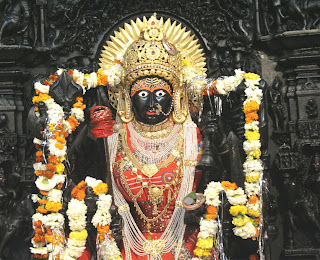

Picture of Goddess Tripura Sundari Temple Banswara Rajasthan

The Goddess with eighteen arms is seen inside the sanctum on a lion statue. The idol is made of reddish black Kastic pathar. Shri Yantra (the symbol of Hindu tantra) is built at her feet. Tripura Sundari is so called because she is seen in her three different forms such as that of a lion, peacock and seated on a lotus, and appears as Kumarika, a young girl in the morning; as an attractive young- maid in the mid-day, and an adult woman in the evening. The backdrop of the main shrine is carved with the winter images of the nine Durga. There are also shrines dedicated to Hanuman which is seen at the entrance and Neeelkanth Mahadev at the backside. The Kalyan Sagar Lake in the eastern side of the temple adds to its beauty.

Festivals and Events

Chaitra Navratra Parv, Ashwin Navartri Parv, Kartiki Purnima, Shukla Paksh Asthmi and Shravan Mass are some of the notable events at the temple.

Temple Timings

The temple opens at 5.00 AM during summer and at 5.30 AM during winter. It is closed at 9.00 PM during summer and 8.30 PM during winter. Here the summer is considered from 1st March to 15th October and winter is from 16th October to 28th February.

How to Reach Tripura Sundari Temple Rajasthan

By Road

Tripura Sundari Temple is located about 55 km from Agartala, the capital city of Tripura, and 3 km from Udaipur which is the district Head-Quarter of the South Tripura district. National Highway 44 connects Tripura with many north- eastern states by road. Bus services are available from Silchar, Guwahati, Karimganj and Shillong.

Railway Station

The nearest railhead is Kumarghat on North-East Railway. It is 1475 km from Kolkata via Guwahati and 140 km from Agartala. Tourists can hire a taxi or take a bus to reach the temple.

The nearest airport is at Agartala.

Wednesday, January 30, 2013

Rameshwaram Ramanathaswamy Temple Tamilnadu

Rameshwaram Temple in Tamilnadu is one of the 12 Jyotirlinga shrines of Lord Shiva in India. Also known as Rameswaram Ramanathaswamy Temple this ancient Shiva temple is situated in the island of Rameswaram, off the Sethu coast of Tamil Nadu. The temple is reached via the Pamban Bridge (Pamban Palam) across the sea. Ramanathaswamy Jyotirlinga Temple is visited by both Vaishnavites and Shaivites, and is regarded as the Banaras of the south.

Significance of Rameshwaram Temple

Rameshwaram is a highly revered pilgrimage center for the Hindus and is believed to be the place from where Lord Rama built a bridge across the sea (known as Adam’s Bridge) to save his consort Sita from Ravana. Also, this is the place where Lord Ram worshipped Lord Shiva to wash away the sin he committed by killing Ravana.

Architecture – Longest Temple Corridor in India

Rameshwaram Shiva Temple is a 17th century ancient Hindu temple and a typical example of Dravidian style of architecture. Situated near the sea on the eastern side of the island, the temple is renowned for its towering gopurams, huge walls and a gigantic Nandi Bull and also recognized for the largest temple corridor in India. Extending to about 4000 feet in length, this pillared corridor has about 4000 pillars. These granite pillars are built on a raised platform and are carved with beautiful images.

Picture of Longest Temple Corridor at Rameshwaram Ramanathaswamy Temple in Tamilnadu India

The eastern Rajagopuram rises to a height of about 126 feet and has nine levels. To worship the presiding deity of Lord Ramanatha, pilgrims enter through the eastern gopuram. The idol of Lord Hanuman is seen here. Next is the Nandi Mandapa enshrining the flag staff and the Nandi. The huge image of this celestial bull is made of lime stone. The Nandi is flanked by the images of the ocean gods, Mahodathi and Ratnakara. On either side of the sanctum are the shrines of Vinayaka and Subramanya. Inside the sanctum is the idol of Ramanathaswamy whose Shiva Linga has marks of Hanuman’s tail.  Decorated with silver kavacha, the Shivling is offered abhishekam with the holy Ganga water.

A canopy is seen in the front mandapa, which has carved images of Rama, Sita, Lakshmana, Hanuman with the two Lingas brought from Kailas, and Sugriva who appears in the position of informing Rama about Hanuman’s return. The other canopies in the front hall are decorated with elegantly carved figures of Hanuman, Gandhamadhana Linga and Agastya Linga.

Parvathavardhini

The idol of Parvathavardhini, who is the consort of Lord Ramanatha, is enshrined separately to His right. A Sri Chakra is installed inside. The significance of the shrine is that the idol of the Goddess is situated to the right of the Lord’s shrine. The idol is beautifully decorated on Fridays and taken around the temple corridor in a golden palanquin.

Vishwanatha and Visalakshi

Lord Vishwanatha or Vishwalinga shrine is located to the north of Ramalinga shrine. This is said to be one of the two Lingas brought by Hanuman from Mount Kailash. Custom is that Pujas are first performed to Vishwalinga and then to Ramalinga. Visalakshi, the consort of Vishwanatha, is enshrined in the first inner corridor.

Sayanagruha (Palliyarai)

Close to the Visalakshi shrine, in the north-eastern corner of the corridor, is the Sayanagruha. From the main shrine, the golden image of the Lord is brought here every night and placed in the Oonjal (swing) next to the Devi’s golden idol. Sayana puja and the early morning puja are performed here.

Other Shrines

There are also shrines dedicated to SethuMadhava and Goddess Lakshmi. Sethu Madhava is also called as Sweta Madhava. The term Sweta means white stone with which the image is made.

Rameswaram Theertham (Water Springs)

There are 64 Theerthams in Rameswaram, of which 22 Tirthas are inside the Rameshwaram Temple. These springs are said to possess curative properties. It is said that these theerthams were created by Lord Rama when he fired arrows in the sand. A holy dip in these springs is considered to be of great significance.

Puja Timings

The temple is opened from 5.00 AM to 1.00 PM and from 3.00 PM to 9.00 PM.

Temple Festivals

Major festivals celebrated here are Thai Amavasi (January), Sivarathiri (February - March), Thirukalyanam (July - August) and Mahalaya Amavasi (September).

How to Reach Rameshwaram Temple

Nearest domestic airport is at Madurai which is 173 km from Rameswaram Shiva Temple. Madurai is the nearest railhead. Two trains ply daily between Rameswaram and Madurai.

Rameshwaram is well connected by road to all main towns. The island-town is connected to the mainland by the Pamban Bridge. Rameshwaram is 527 km from Chennai, 173 km from Madurai, 315 km from Kanyakumari and 273 km from Tiruchirapalli.

Tuesday, January 29, 2013

Kanyakumari Devi Temple in Tamilnadu

Kanyakumari Temple is a famous Goddess Parvati temple located on the seashore of Kanyakumari, the southernmost tip of India, in Tamilnadu. Kanyakumari is the merging point of three seas; the Arabian Sea, the Indian Ocean and the Bay of Bengal. This is an ancient temple, dedicated to Devi Kanya Kumari. She is worshipped as Kumari Amman (the virgin goddess) who is one of the forms of Goddess Shaki. Kanyakumari Devi is also known as Bhagavathy Amman, Kanya Devi, and Devi Kumari. The town is named after the deity.
Temple Architecture
Kanyakumari Bhagavathy Amman Temple is known for its architectural beauty and stands facing the shoreline. Main entrance to the temple is through the northern gate and the deity faces east. A door to the east of the shrine is opened only five times a year. There are three corridors which encircle the sanctum. Though there are no special shrines in the outer corridor, there is a Navarathiri mandapam and a pathway that leads to the second corridor. Devotees can see the flag mast or Kodisthambam from where a clear view of the Goddess is seen. A symbol of a Hindu Nun, the Goddess is seen in a black stone image in the sanctum with a garland. The most significant feature of the deity is the glittering diamond nose ring that is visible from a distance. Other deities of the temple are Vijayasundari and Balasundari, friends of the Goddess. One can see 11 theerthams in the surrounding area. There are two rocks rising out of the ocean on the southeast of the Kanyakumari Amman Temple. Footprints of the goddess are seen on one of the rocks. Another one is the rock where Swami Vivekananda meditated and attained enlightenment.


Picture of Goddess Devi Kanya Kumari at Kanyakumari Devi Temple, Tamilnadu

Legend of Kanyakumari Temple

Legend has it that a demon named Baanaasuran caused damages to the Devas and the public. The helpless victims sought Lord Mahavishnu for help. The Lord in turn directed them to pray Goddess Shakthi to destroy the demon. The Goddess answered their prayers and appeared as a young virgin girl at Kanyakumari. She started penance to marry Lord Shiva at Suchindram temple (about 11 km away). However the wedding did not happen. The rice and cereals remained uncooked and turned into sand and seashells. These are scattered along the seashore and the Devi became a virgin goddess.

Offerings

Besides the usual abhishekam and archanas, people lit lamps in the temple and offer new saris to the goddess. 

Kanyakumari Temple Visiting Hours

The temple is open from 4.30 AM to 11.45 AM and 5.30 PM to 8.45 PM.

Temple Festivals

A ten-day festival called Vaikasi Visakam is held during the Tamil month of Vaikasi (May/June) with a Boat Festival. Navarathri is also celebrated during September/October.

How to reach Kanyakumari

Kanyakumari is 25 km from Nagercoil, 91 km from Tirunelveli and 242 km from Madurai. Trivandrum International Airport at Thiruvananthapuram is the nearest airport, 93 km away. Kanyakumari is well connected by train and bus services also.


the 133 ft Thiruvalluvar Statue at Vivekananda Rock Memorial in Kanyakumari

Tourist Attractions in Kanyakumari

There are numerous tourist attractions and places to visit in Kanyakumari, apart from the spectacular views of Sunrise and Sunset. Some of the major tourist places in Kanyakumari include Kanyakumari Beach, the 133 ft Thiruvalluvar Statue, Vivekananda Rock Memorial, the Gandhi Memorial, and the Government Museum. Tourist places located a short drive from Kanyakumari are Vattakottai (Round Fort), the Snake Temple at Nagercoil, Suchindram Temple, Udayagiri Fort and Padmanabhapuram Palace.

Monday, January 28, 2013

Swamimalai Murugan Temple Tamilnadu

Swamimalai Murugan Temple is a famous Lord Muruga Temple situated in Swamimalai, around 5 km from Kumbakonam, in Thanjavur district of Tamil Nadu, India. The temple is the fourth one among the Arupadai Veedu or six holy abodes of Lord Muruga. The presiding deity here is Lord Swaminathan who according to legends explained the Pranava Mantra, OM, to his father Lord Shiva himself. Swamimalai is also called as Thiruveragam. The other five Arupadaiveedu Temples of Lord Muruga are Palani Temple, Thiruthani Temple, Pazhamudircholai Temple, Thiruchendur Temple, and Thiruparamkunram Temple.
Temple Architecture
Swamimalai Muruga Temple is erected in an artificially created mount which is about sixty feet height. There are about sixty stone steps, signifying the Hindu cycle of sixty years, leading to the temple. The temple has three gopurams with three praharams. The five-storey gopuram on the southern side is carved with statues.  The praharams are peculiarly arranged such that the first Praharam is at the base of the hill, the second one is halfway up the hill and the third is at the top, surrounding the sanctum of Lord Swaminathan. A unique feature of the temple is that the Lord has an elephant (facing his sanctum) as his vehicle and not the peacock.


Swamimalai Murugan Temple in Tamilnadu India - Arupadai Veedu of Muruga

Temples dedicated to Lord Sundareswarer and Goddess Meenakshi are on the base.  A shrine dedicated to Netra Vinayakar is located near the flagpole. An idol of Lord Subramanian with Valli is seen in the inner prakaram and he is called as Senapati. In the southern side of the inner prakaram, Lord Subramanian is worshipped as Sabapathi who is seen with Devasena, with his arms stretched like that of Natarajar. There are also idols of Shammukhar with his consorts Valli and Devasena. Besides, the temple also enshrines the images of Mahalakshmi, Saraswathi, Veerabaagu, Arunagirinathar, Surya, Chandra, Idumban, and Dhandayutapani.

The stala vriksham (holy tree) is the Nellimaram which is said to be a manifestation of Bhudevi. The theerthams (sacred water sources) are Vajra theertham, Saravana Theerhtam, Netra Pushkarini and Kumaratturai (Kaveri). Legend has it that a blind devotee was restored with sight after a dip in the Netra Theertham, while he was on his way to the Netra Vinayakar shrine.

Golden Chariot of Swamimalai Temple

The golden chariot of the temple is worth mentioning here. It is made of seven kilos of gold, 85 kilos of silver and other metals such as copper, exquisitely lit with electric bulbs.

Legend of Swamimalai Temple

According to a legend, Sage Bhrugu, before starting a hard penance, got a boon that anyone who disturbed his penance would forget his knowledge. The power of his penance was so severe that the fire originated from his head and reached up to the heaven. The scared Devas approached Lord Shiva and he extinguished it by placing His hand on Sage Bhrugu’s head. Consequently, Lord Shiva became ignorant of the highest wisdom called Brahma Jnana. It is believed that he regained the wisdom from Lord Murugan who described Him with the Pranava Mantra 'OM' in Swamimalai.

Pooja Schedules

Six worship services (six kalams) are performed daily.  Usha Kalam, Kalasandhi and Uchikala poojas are performed in the morning. Sayaratchai and Rendam kalam are performed in the afternoon. Arthajama pooja is held in the night.

Swamimalai Temple Festivals

Festivals celebrated here are monthly Kiruthigai festival, temple car festival in April, Vaikasi Visakam festival in May / June, Navaratri festival in September/October; Skanda Sashti festival which lasts for 6 days in October / November, Thiru Karthikai festival in November / December, Thaipusam festival in January / February; and Pankuni Uttiram festival in March /April.

How to reach Swamimalai Temple


Swamimalai Murugan Temple is about 250 km from Chennai, on the way to Kumbakonam via Thiruvalansuzhi. The temple is about 2 km from the bus stand and railway station. The place is well connected to Kumbakonam, Tiruvidaimarutur, Mayiladuthurai, Papanasam, and Tanjavur. 

Nearby sightseeing

Thiruvalanjuli Kabardeeshwarar Temple or Vellai Vinayagar Temple (White Ganesha Temple) located nearby is worth visiting.

Sunday, January 27, 2013

Somnath Jyotirlinga Temple in Gujarat

Somnath Temple or Somnath Jyotirlinga Temple is situated in the Prabhas Kshetra near Veraval in Saurashtra, on the shores of the Arabian Sea, on the western coast of Gujarat in India. The temple is dedicated to Someshwara, another name of Lord Shiva, with moon on his head and is first among the twelve Jyotirlinga Temples in India. Built at the shore of the Arabian ocean on the western corner, Somnath Shiva Temple is a well-known pilgrimage center in India. This Jyotirlinga shrine dedicated to Lord Shiva is also known by other names such as Deo Pattan, Prabhas Pattan, or Somnath Pattan. Somnath literally means “The Protector of Moon God”.
Someshwar Mahadev Temple is believed to have built out of gold originally by Somraj, the Moon God himself, then rebuilt by Ravana in silver, then by Lord Krishna in Wood, and then by Bhima (the strongest of the five Pandava brothers) in stone. The present Somnath temple is the seventh one reconstructed beyond six repeated destruction by the Muslim invaders.


Architecture of Somnath Mahadev Temple

Though built in the Kailas Mahameru Prasad style, the Somnath Temple’s architecture influences that of Jain
style. The temple consists of Garbhagruh, Sabhamandap and Nrityamandap with 150 feet high Shikhar and a Kalash at its top. The dome of the temple is the biggest one. The Somanath temple faces east and has a vast central hall with three entrances, each protected by a tall porch. Added attractions are the carved doorways, the sculptured representations of Nandi (the celestial bull) and the figures of goddesses. In the balconied corridor is the damaged form of Nataraja statue. Shri Kapardi Vinayak and Shri Hanuman Temple are other spots to be noted in the temple. This temple is said to be the place where Lord Krishna performed all his Lilas. There is a small cave in the temple where a lamp burns continuously.


History of Somnath Jyotirlinga Temple

According to myths, moon was married to the 27 daughters of Daksha Prajapati. But he was preferential to Rohini and ignored other queens. The angry Daksha cursed Moon that he would lose his beauty and brightness. Eventually, moon came down to Prabhasa with Rohini and worshipped the Sparsa Linga of Somnath.  Subsequently, he was blessed by Lord Shiva to grow and shine in the bright half. It was Lord Brahma who installed the Brahmashila and paved way for the construction of the temple.

Somnath Temple Darshan Timings

Somnath Temple is open for darshan from 6:00 am to 9:00 pm. Aartis are conducted three times a day. First Aarti at 7.00 am second one at 12.00 Noon and third one at 7.00 pm.

Somnath Jyotirlinga Temple Festivals

Somnath Mahadev Fair - This fair is celebrated in November, to mark the birth of Kartikeya (Lord Muruga), son of Lord Shiva. Also known as Kartik Purmima Mela, the fair features stage shows, folk dances and instrumental music in the Somnath Temple.

Maha Shivaratri - Shivratri Festival at Somanath Temple is another major festival celebrated here in the month of February – March every year. Thousands of Hindu devotees visit this Jyotirlinga shrine during Shivaratri Festival.

Other Tourist Attractions Near Somnath Temple

A sound and light show called “Jay Somnath” is displayed in the temple every night during 8.00 to 9.00. There is a beach outside the temple where visitors can enjoy the beautiful sunset point, Vallabhghat. 

Bhalka Teerth

This holy Bhalkha Teerth is located 5 km on Prabhas Veraval highway. It is said to be the place where Lord Krishna was struck by an arrow of a tribal.

Dehotsarg Teerth

Also known as Shri Krishna Neejdham Prasthan Tirth, Dehotsarg Teerth is located on the banks of Hiran, about 1.5 km from Somnath Temple.

Tourist Places near Somnath Temple

Other nearby tourist places near Somnath include Veraval Beach (5 km), Gita Mandir (1 km), Somnath Museum, Junagadh Gate, Ahalyeshwar Mahadev Temple built by Queen Ahalyabai, Lakshmi Narayan temple, Balramjiki Gufa, Mahaprabhuji's Bethak, Triveni Sangam, Shree Parashuram Temple, Sun Temple, Prachi and Shashibhushan temples, Shree Veneshwar Mahadev Temple, Chorwad Beach (26 km), and Gir National Park (43 km).

How to Reach Somnath Temple

By Road / Bus

Somnath is well connected by road to nearby places such as Veraval (7 km), Junagarh (85 km), Porbandar (122 km), Bhavnagar (266 km), Ahmedabad (465 km), and Mumbai (889 km).

By Train / Railway Station

Veraval Railway Station is the nearest railhead, 7 km from Somnath. It is connected to Ahmedabad and some other cities in Gujarat. Veraval Railway Station Code is VRL.

By Air / Flight

The nearest airport is 55 km away at Keshod, which is linked to Mumbai. Regular buses and taxis are available between Keshod and Somnath. The nearest international airport is Sardar Vallabhbhai Patel International Airport at Ahmedabad.

Saturday, January 26, 2013

Palani Murugan Temple in Pazhani Tamilnadu India

Palani Murugan Temple, also known as Pazhani Temple or Dhandapani Murugan Temple or the Hill Temple of Palani, is one of the most famous Murugan temples in India situated in the town of Palani, about 100 km southeast of Coimbatore, in Tamilnadu, India. This ancient temple, built during the 7th Century AD by Cheaman Perumal - a ruler of Kerala, is the third Arupadai Veedu among the Arupadaiveedu or the six abodes of Lord Muruga. Situated 60 km from Dindugul in Tamil Nadu, this famous pilgrimage center is located atop the Sivagiri Hill at an elevation of 1500 ft above sea level. The presiding deity is Lord Dandayudhapani Swami. The other five Aarupadai Veedu Murugan temples are Thiruchendur Murugan Temple, Swamimalai Murugan Temple, Thiruthani Murugan Temple, Pazhamudircholai Muruga Temple, and Thiruparamkunram Temple.
Palani Murugan Temple is also known by other names such as Tiru Avinankudi, Palani Subramanya Temple, Palani Murugan Kovil, Dandayudhapani Swami Temple, and Arulmigu Dhandayuthapani Thirukkovil.
 

Palani Murugan Temple in Pazhani Tamilnadu India

Picture of Palani Murugan Temple seen at night with lights on

Medicinal power of the Palani Murugan Idol

Lord Dandayudhapani of Palani Temple is seen in a standing position with a stick in his hand. Wearing only a loincloth, the Lord seems like a person who has thrown out all luxuries. The idol of the Palani Hill Temple is unique - it is believed that the idol of the presiding deity is made out of a mixture known as Navabashanam or Navapaashanam. In Sanskrit Nava means both 'new' and also 'nine'. The word bashana means 'poison' and also mean 'mineral'. The amalgam containing the nine kinds of medicinal minerals is blended together in certain rare proportions and the resultant material forms a hardened wax. This was prepared by Bhogar, a siddha (siddha means a person who has achieved spiritual perfection or enlightenment). Due to the amalgamation, the poisonous nature of all these metals was tied together and converted into a useful mixture with medicinal and curative values. The nine medicinal minerals are Veeram, Pooram, Rasam, Jathilingam, Kandagam, Gauri Pasanam, Vellai Pasanam, Mridharsingh and Silasat.

According to Sidhha Medicine practice, these poisonous elements have highly curative powers for many diseases.

Story of Palani Temple

Story of Palani Temple Pazhani History GnanapazhamAccording to legends, once Sage Narada visited Lord Shiva at Mount Kailash. He gave a fruit to the Lord and told him that it was a unique one, the fruit of wisdom (in Tamil it is called as Gnanapazham). Lord Shiva decided to give the fruit to his children – Lord Kartikeya and Lord Ganapati. But the sage advised that this fruit should not be cut because its power would be reduced.

Consequently, a competition was arranged to get the fruit. The competition was that the son who first surrounds the earth would get the fruit. Without delaying, Lord Murugan started his trip around the world on his divine vehicle, the peacock. But Lord Ganesha who believed that his parents were his world, just surrounded Lord Shiva and Goddess Parvati and claimed the fruit. On returning, Lord Subrahmanya found that Lord Ganesha had already won and felt that he was tricked. He decided to leave the Mount Kailash and reached Tiru Avinankudi at the foot of the Sivagiri Hill. Lord Siva and the Goddess tried to appease their son by saying that he himself was the fruit (pazham) of all wisdom and knowledge; ‘Nee’ means you. For this reason, the place was called ‘Pazham Nee’ or Palani or Pazhani.

Bhogar Shrine at Pazhani Temple

Bhogar who created the Navabashana idol and sanctified the deity is said to have lived before 3,000 B.C. The shrine of Bhogar is found in the southwestern corridor of the hill temple. There are also images of Nava Durga or Bhuvanesvari and the Maragadha (emerald) Shiva Lingam who were worshipped by him. There is an underground passage which is said to link the sanctum sanctorum with the Bhogar shrine.  The walls of the shrine describe the history of the temple.

Other Temples in Palani

Palani Hill Temple comprises various other shrines such as Anandha Vinayagar Sannadhi (situated on the outer prakaram of the temple), Valli Temple, 18-Padi Karuppanna Swamy Temple and Idumban Temple.

Valli Spring

This is a holy tank which flows from a mountain spring. It is called as Valli Sonai and is found on the Elephant path which was constructed for the elephants to climb the hill.

Kavadi

Kavadi is significant to all Murugan temples in India and abroad. ‘Kavi’ means ‘saffron’ implying simplicity and ‘adi’ means ‘foot’ meaning pilgrimage. Devotees bring different types of kavadis to the temple by foot.

Tonsuring in Palani

Tonsuring, or shaving the head, is an important feature of Pazhani Hill Temple. Devotees can perform tonsuring by paying Rs.10/- at the Tonsuring sheds.

Palani Murugan Temple Festivals

Thai Poosam Festival or Thaipusam, Agni Nakshatra, Kandhar Shasti (Shasti Vratam in the month of Aippasi), and Vaikasi Visagam are the most important festivals celebrated at Palani Muruga Temple. Other festivals celebrated here include Thirukarthigai, Pankuni Uttiram (March - April), Chitra Pournami, and Aani Annabhishekam.

In the Tamil month of Aadi, the Pazhani Temple celebrates the Aadi Perukku, Aadi Krithigai, Aadi Amavasai, and Aadi Laksharchana festivals.

Temple Timings – Visiting Hours

Palani Murugan Temple opens daily from 6:00 AM to 8:00 PM. On festival days the temple is opened at 4.30 AM. The puja starts at 5 AM with Visvarupa Darshana. Vilaa Pooja is conducted at 6.30 AM, followed by Siru Kall Pooja at 8.00 AM., Kaala Santhi at 9.00 AM., Utchikkala Pooja at 12.00 noon, Raja Alankaram at 5.30 p.m., Iraakkaala Puja at 8.00 p.m., Golden Car Darshan at 6.30 P.M and Rakkalam at 8 PM

How to reach Palani Hill Murugan Temple in Pazhani

By Train / Railway Station

Palani Railway Station, on the Dindigul - Coimbatore meter gauge line, is the nearest railway station (5 km) to reach Palani Murugan Temple. Served by Southern Railways, Rameshwaram Express, Coimbatore Express, Palakkad Passenger, and Palakkad - Rameshwaram Passenger are some of the major trains passing through Pazhani Railway Station. The Railway Station code of Palani is PLNI.

Kodaikanal Road Railway Station (KQN) and Dindigul Junction Railway Station (Station Code - DG) are the other railway stations nearby 46 km and 48 km respectively.

By Flight / Airport

Coimbatore Airport (CJB) at Peelamedu is the nearest airport to reach Palani Hills, about 100 km away. Coimbatore Airport operates regular flights to major Indian cities Chennai, Mumbai, Bangalore, Delhi, Ahmedabad, Kozhikode, Trivandrum, and Kochi.

Other airports near Palani Hills are Madurai Airport (IXM) (85 km), Bengaluru International Airport (BLR) (314 km) and Chennai International Airport (MAA) (413 km).

By Road / Bus / Taxi

Palani is well connected by road from major cities in Tamil Nadu, Kerala, and Karnataka. Palani Hills is situated 75 km from Pollachi, 122 km from Palakkad, 373 km from Bangalore, and 489 km from Chennai. Palani Bus Station, operated by Tamil Nadu State Transport Corporation (TNSTC), operates bus services to several major cities in Tamil Nadu and nearby states. Bus services are available from Pazhani to Madurai, Kodaikanal, Kanyakumari, Pollachi, Thiruvananthapuram, Palakkad, Guruvayoor, Thrissur, Coimbatore, and Chennai.

Palani Devasthanam Information Center is located at the bus station for helping pilgrims and tourist to this famous sacred destination in India. The temple authority has arranged haulage winches and rope cars to reach the hill temple for quick conveyance.

Friday, January 25, 2013

Pazhavangadi Ganapathi Temple in Trivandrum, Kerala

Pazhavangadi Maha Ganapathi Temple is one of the most famous Lord Ganesh temples in Kerala, situated at East Fort, Thiruvananthapuram. Located in the heart of Trivandrum city, the original idol of the Pazhavangadi Ganapathy Temple is a small idol of Lord Ganesh, with the right leg in the folded posture. Pazhavangadi Ganapati Temple is one of the main temples in Thiruvananthapuram. The temple is situated within walking distance from Sree Padmanabhaswamy Temple of Lord Vishnu.
Other deities worshiped at Pazhavangadi Maha Ganapati Kovil are Lord Ayyappa, Goddess Durga, Nagaraja, and Brahmarakshas. Devotees can see beautiful paintings of the 32 forms of Lord Ganesh inside the temple complex.


Pazhavangadi Ganapathi Temple in Trivandrum Kerala

Pazhavangadi Temple History

The original Ganesha idol installed in the temple was worshiped by a soldier of Travancore Army stationed at Padmanabhapuram. In 1795 A.D, when the capital of Travancore was changed to Thiruvananthapuram, the garrison was also shifted and the idol was installed at its present place at Pazhavangati.

Offerings to Lord Ganesh

The main vazhipadu (offering) of Pazhavangadi Maha Ganapati is the breaking of coconut for removing obstacles and fulfillment of any desire. Ganapathi Homam, Appam, and Modakam are other main offerings to Lord Ganesh.

Festivals Celebrated at Pazhavangadi Ganesh Temple

Vinayaka Chaturthi (Ganesh Chaturthi), Ganesh Jayanthi, Varad Chaturti, and Sankashti Chaturti are the main festivals in Pazhavangadi Maha Ganapathy Temple. Special poojas (pujas) are performed for other Hindu festivals including Thiruvonam, Vijaya Dasami, Ayilyam, Sahasra Kalasam, Thirkkarththika, Thirvathira, Makara Vilakku, Maha Shivaratri, Vishu, Thriveda Laksharcchana, and Nira Puththari.

Temple Dress Code

To enter inside the main complex male devotees need to wear Mundu (Veshti or Dothi or Laacha). Any traditional dress code like Saree, Churidar, Salwar Kameez, or Pavadai Chattai is allowed for ladies.

How to Reach

Sree Pazhavangadi Mahaganapathy Temple is just 1.5 kms from Trivandrum Central Railway Station and Thiruvananthapuram Central Bus Station. The nearest City Bus Stand is East Fort (Kizhakke Kotta). Trivandrum International Airport is about 8 km from the temple.